
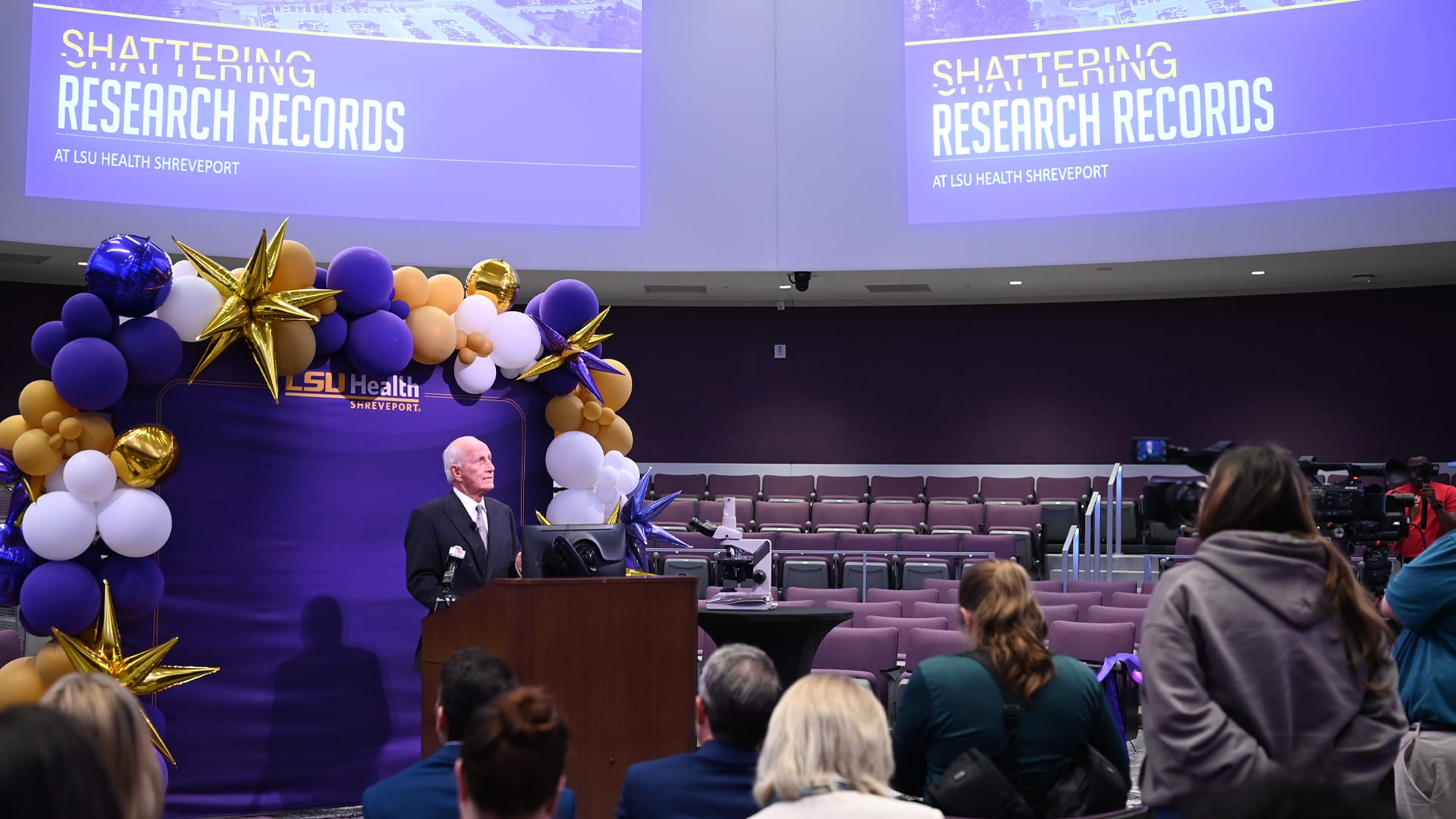
LSU Health Shreveport Research Funding Surges 71% to Record $44.3 Million
Shreveport, La. – LSU Health Shreveport secured a record $44.3 million in external research funding during Fiscal Year 2026, an increase of nearly 71% over the previous year and another major milestone in the rapid growth of the institution’s research enterprise.
The total represents an increase of more than $18.3 million in a single year, rising from $25.9 million in FY25. The historic growth reflects a combination of major competitive federal awards, continued recruitment of accomplished researchers from top-tier institutions across the US, increased grant submissions, diversification of funding sources and expanding research collaborations across Louisiana.
“This record reflects years of deliberate work to build a stronger, more competitive research enterprise,” said Oren Rom, PhD, RD, Assistant Vice Chancellor for Research at LSU Health Shreveport. “At a time when the national research funding environment has been extremely challenging, our faculty responded by working harder, collaborating more and pursuing new opportunities. What we are seeing is not one grant or one recruitment driving our success. It is a culture of research excellence that has been established across this institution.”
Among the major milestones contributing to LSU Health Shreveport’s historic year:
- Continued recruitment efforts that have brought 26 new researchers to LSU Health Shreveport from top-tier institutions across the nation, bringing millions in federal funding to our region over the last two years. Of the 26 new faculty members recruited, 10 new researchers joined LSUHS in FY26.
- $44.3 million in external research funding, up nearly 71% from $25.9 million in FY25.
- 225 grant proposals submitted, an increase of roughly 10% from the previous year, and evidence of growing participation in externally funded research.
- A five-year, $7.5 million National Science Foundation award establishing LSU Health Shreveport’s new Center for Post-Transcriptional Regulation, the first and largest NSF-funded center grant in school history.
- An $11 million Phase 2 NIH COBRE renewal for the Center for Applied Immunology and Pathological Processes, or CAIPP, supporting research infrastructure and the development of independently funded investigators.
- The first two NIH K99/R00 Pathway to Independence Awards earned by postdoctoral researchers while training at LSU Health Shreveport, demonstrating the institution’s growing ability not only to recruit successful scientists, but to develop the next generation of them.
- Expanded partnerships within the LSU Flagship and with other Louisiana institutions including Louisiana Tech University, creating new opportunities for collaborative research, shared infrastructure and interdisciplinary training.
Diversifying a Growing Research Portfolio
One of the year’s most significant achievements was LSU Health Shreveport’s success in expanding beyond its historically NIH-focused funding portfolio.
For years, approximately 80 to 85% of LSU Health Shreveport’s research funding portfolio has come from the National Institutes of Health. Facing an increasingly uncertain federal funding environment, institutional research leadership placed greater emphasis on identifying and competing for additional sources of support.
That strategy produced a landmark result with the $7.5 million NSF award to establish the Center for Post-Transcriptional Regulation. The grant brings together investigators across multiple disciplines to study how RNA molecules and protein modifications regulate metabolism, while creating research and training opportunities spanning from high school students, undergraduate, graduate students, postdoctoral fellows and faculty.
“The NSF award was a major milestone because it demonstrated our ability to compete successfully outside of our traditional funding strengths,” Rom said. “It took nearly a year of collaboration and planning across a large team of investigators. That success reinforced something important for us: we can diversify, we can compete at the highest levels and we can create new opportunities by bringing the right people together.”
The year also included an $11 million NIH COBRE renewal for LSU Health Shreveport’s Center for Applied Immunology and Pathological Processes, led by Andrew Yurochko, PhD. The program strengthens biomedical and immunology research infrastructure, while providing mentorship and resources designed to help early-career faculty develop into independently funded investigators.
Recruiting Great Scientists and Developing Our Own
Recruitment has remained a major component of LSU Health Shreveport’s research growth. During the institution’s current expansion, 26 researchers have joined LSU Health Shreveport, bringing new expertise, laboratories, research programs and externally funded projects to North Louisiana.
Rom said the institution’s concentrated research environment, access to advanced equipment, competitively low cost of conducting research and Louisiana’s low cost of living have helped LSU Health Shreveport attract investigators from across the nation.
But FY26 also provided evidence of another important evolution: LSU Health Shreveport is increasingly developing nationally competitive researchers from within.
For the first time in school history, two postdoctoral researchers earned NIH K99/R00 Pathway to Independence Awards while training at LSU Health Shreveport. Among the NIH’s premier career-development mechanisms for early-career scientists, the program is designed to help outstanding postdoctoral researchers transition into independent research careers.
“We have been very successful at recruiting investigators to come here with K99 or R00 funding, but generating them ourselves is another thing entirely,” Rom said. “Seeing two of our postdocs earn those awards back-to-back was incredibly meaningful. These awards can change the trajectory of a scientist’s career. It shows that we are building an environment where the next generation of outstanding investigators can develop right here at LSU Health Shreveport.”
That growth is reflected throughout the institution. LSU Health Shreveport researchers submitted approximately 225 grant applications during FY26, roughly 10% more than the previous year, as established investigators and early-career researchers alike pursued new opportunities.
A Team-Based Science Approach
This research growth is also increasingly collaborative. LSU Health Shreveport recently signed a Memorandum of Understanding with Louisiana Tech University creating a framework for collaborative research, student training, shared access to specialized laboratories and equipment, joint grant development, technology transfer and workforce development.
The partnership combines LSU Health Shreveport’s strengths in biomedical, clinical and translational research with Louisiana Tech’s expertise in engineering, biomedical engineering, micromanufacturing, advanced manufacturing and technology development.
“Science today is team science,” Rom said. “Often times, the questions we are trying to solve are too complex for any one investigator, discipline or institution. The more we connect our researchers with complementary expertise, whether that is at Louisiana Tech, within the LSU System or with partners across the country, the more competitive we become and it increases our opportunity to translate discovery into something that improves people’s lives.”
Within the LSU System, LSU Health Shreveport continues to strengthen research collaborations with LSU, LSU Health New Orleans, Pennington Biomedical Research Center and the LSU AgCenter, institutions that unify to create the new LSU Flagship. LSU Health Shreveport’s research growth greatly impacts the LSU Flagship’s larger goal of becoming a Top 50 Research Institution.
Creating Space for What Comes Next
The unprecedented growth has also created a new challenge: LSU Health Shreveport needs more lab space to grow.
Through the LSU Health Sciences Foundation, the former Sears property at Mall St. Vincent is planned for transformation into new Class A research space as part of LSU Health Shreveport’s Research Expansion Project.
The facility will provide new capacity for research in areas including cardiovascular disease and cancer, while freeing existing laboratory space on LSU Health Shreveport’s main campus for continued growth in fields such as microbiology, infectious disease, virology, neuroscience and addiction research.
Research With Real-World Impact
Ultimately, the significance of $44.3 million extends beyond the record itself. Behind those dollars are scientists, trainees, laboratories, discoveries and new approaches to diseases that affect families in Louisiana and around the world.
“The number is extraordinary, and we are incredibly proud of it,” Rom said. “But funding is not the ultimate goal. Funding gives our scientists the ability to ask important questions, train the next generation of researchers and make discoveries that can improve and save lives. That is what this growth is really about, and we believe we are only getting started.”